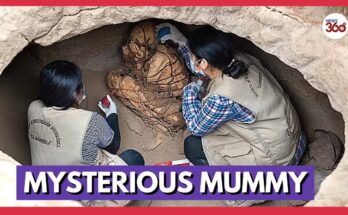
High in the windswept peaks of the Andes, where the air is thin and the temperature rarely rises above freezing, a secret from the past lay frozen for centuries. It was here, at an altitude exceeding 6,000 meters, that a 15-year-old girl, known to archaeologists as the “Ice Maiden,” met her tragic fate. She lived during the height of the Inca civilization, a society that spanned vast stretches of the Andes, weaving together religion, astronomy, and a rigid social hierarchy. Her story, frozen in time, offers a haunting glimpse into a world where devotion to the gods often came at the ultimate price.
Approximately 500 years ago, the Inca Empire was at its zenith, ruled from the majestic city of Cusco. The empire was held together not only by military might but by a deeply spiritual culture that revered the forces of nature. Mountains were considered sacred, rivers divine, and the sun itself, Inti, the most powerful deity of all, demanded worship and sacrifice. Children, often chosen for their beauty, health, and social standing, were selected as offerings to ensure the favor of the gods.
This young girl, whose name has been lost to history, was one such offering. Archaeologists believe she was of noble lineage, possibly chosen because of her purity and physical perfection. The ritual that led to her death was one of both reverence and terror. She would have been taken to a remote mountaintop, far from human settlements, where the Inca priests performed the elaborate ceremonies of Capacocha—a sacrificial rite meant to appease the gods and secure prosperity, fertility, and protection for the empire.
The conditions of her resting place played a crucial role in preserving her body. As she lay on the mountaintop, the freezing temperatures, combined with the extreme altitude and arid air, slowed decomposition to a near standstill. The environment was so inhospitable that microorganisms could not survive, effectively placing her remains in a deep, natural slumber. Over the centuries, her tiny frame became a time capsule, keeping intact the details of her final days: the folds of her clothing, the offerings placed around her, and even the traces of food and drink that had been given to sustain her for the journey to the afterlife.
It was not until 1999 that the Ice Maiden was discovered. Archaeologists, conducting careful excavations in the high Andes, stumbled upon her mummified form. The moment of discovery was extraordinary: the girl appeared as if asleep, her features remarkably intact despite half a millennium passing. Her hair, once braided with intricate care, was still discernible, and her delicate face bore the serene expression of someone untouched by time. The preservation allowed scientists to conduct a detailed examination, revealing her diet, health, and even the ceremonial artifacts that accompanied her.
The Ice Maiden has since become one of the most significant archaeological finds in South America. Analysis of her remains revealed insights into Inca culture, health, and ritual practice. She had been given coca leaves, maize beer, and llama fat—items meant to sustain her spirit. Her clothing, made from finely woven textiles, reflected the sophistication of Inca artisans, and the inclusion of miniature figurines suggested prayers or messages to accompany her to the afterlife. Every detail underscored the devotion of a civilization that intertwined human life and death with the divine.
Modern forensic studies also provided a glimpse into the circumstances of her death. Experts concluded that she likely died peacefully, though the exact method—whether by hypothermia, exposure, or a ritual ceremony—remains uncertain. What is undeniable is the reverence with which the sacrifice was conducted; she was not simply killed, but carefully prepared to serve as a bridge between the living and the gods.
Her discovery continues to captivate historians, scientists, and the public alike. Museums now display replicas of her clothing and artifacts, but the girl herself remains in specialized preservation facilities, where scientists can study her while honoring the dignity of her sacrifice. Her story transcends time, a silent testament to the Inca belief that the mountains held divine power and that human offerings could secure the favor of forces far greater than themselves.
The Ice Maiden is more than a preserved body; she is a portal to the past. Through her, we glimpse a civilization whose reach and sophistication are often overshadowed by the mystery of its mountains. She reminds us of the fragility of human life, the devotion of ancient peoples, and the profound ways in which humans have sought to connect with the divine. Five centuries after her death, she remains an enduring symbol of sacrifice, endurance, and the eerie power of the frozen Andes, standing as a mute witness to history, forever suspended in the cold embrace of the mountains she once climbed in life—and in death.