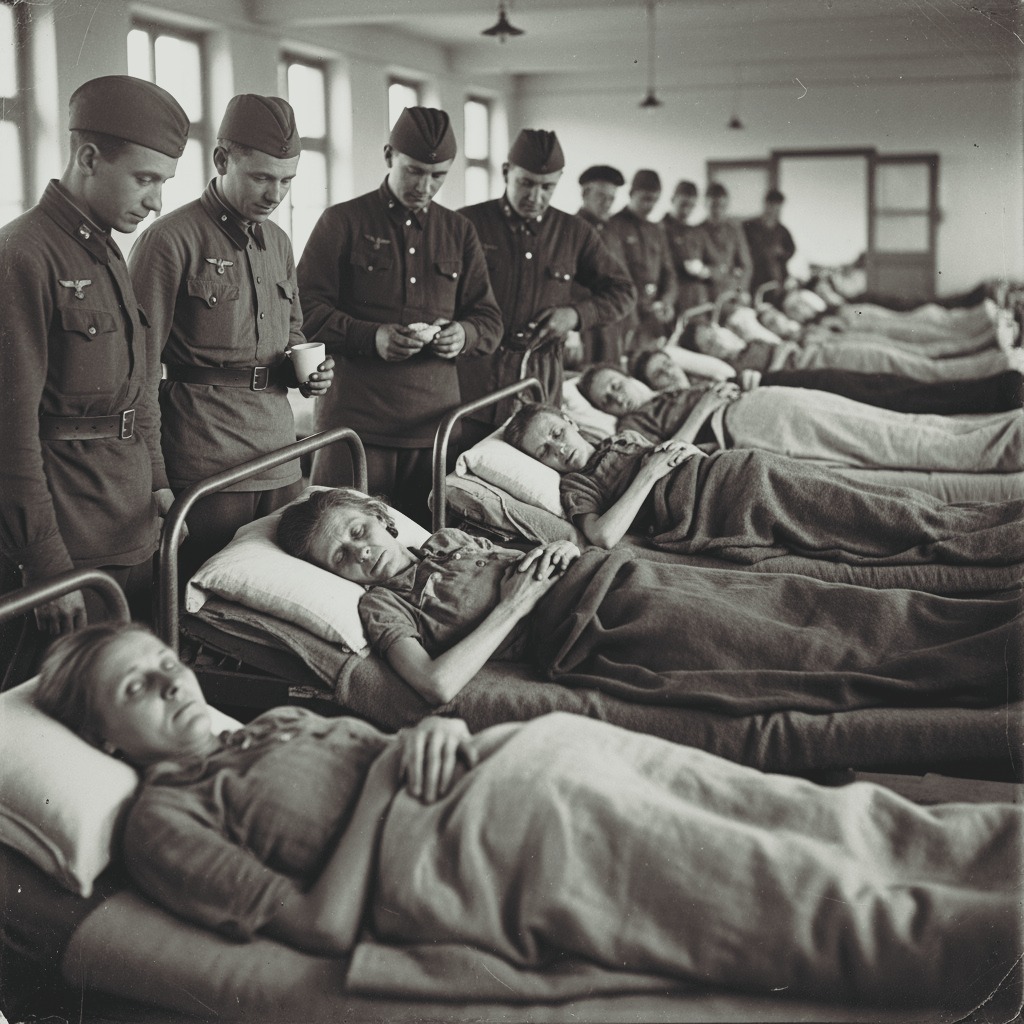
May 2, 1945 — Ravensbrück Concentration Camp, Germany
When the Red Army reached Ravensbrück, they found not liberation, but a landscape of unspeakable suffering. The air hung heavy with smoke and silence. The camp, built in 1939 as the only major Nazi concentration camp exclusively for women, had become a place of death long before the soldiers arrived. Behind the barbed wire and watchtowers lay over 3,000 survivors, their bodies reduced to shadows, their breaths shallow, their eyes hollow with exhaustion. Many were too weak to speak, too frail even to raise a hand in greeting.
Just days earlier, as Allied forces advanced, the SS guards had forced tens of thousands of women on brutal death marches toward the north. The sick, the starving, the ones who stumbled — all were shot and left to rot along the roadside. One Soviet officer described the sight with trembling disbelief: “Corpses lay beside the road like mile markers — each step a story of despair.”
Ravensbrück had been more than a camp; it was an instrument of annihilation disguised as order. Over its six years of operation, more than 130,000 women from over twenty countries passed through its gates. Jews, political prisoners, resistance fighters, Romani women, and others deemed “unfit” by Nazi ideology — all were marked for degradation and destruction. Thousands were executed outright, thousands more perished from starvation, forced labor, and medical experimentation.
In its final months, as defeat loomed for Germany, the camp descended into chaos. Guards fled, killing those who tried to escape and leaving the rest to die slowly. The crematorium burned day and night. When Soviet soldiers entered on May 2, 1945, they found rooms stacked with the dead, and a silence that no victory could fill.
Among those who had passed through Ravensbrück was Gertrud Kolmar, a German-Jewish poet whose voice had captured both the beauty and the brutality of her time. She had been deported to the camp in 1943, and though her body did not survive, her words did. “We must keep the names alive — for the world forgets faster than we die,” she had written, a haunting plea that echoes through history. Her prophecy proved devastatingly accurate.
In the years after liberation, the women who survived Ravensbrück carried their memories like invisible chains. They bore numbers tattooed on their arms, but the true scars lay deeper — in the loss of sisters, mothers, children, and entire worlds. Many never spoke of what they had endured. Others, like Olga Benário Prestes and Liselotte Herrmann, became symbols of resistance and sacrifice. Some returned home to find nothing left — no families, no homes, no acknowledgment of what they had suffered.
Yet a few found the strength to testify. In courtrooms, memoirs, and classrooms, they recounted the experiments, the starvation, the executions — not to relive the horror, but to bear witness. “If we remain silent,” one survivor said, “then they win twice.”
Ravensbrück’s legacy is both unbearable and essential. It reminds the world that cruelty wears many faces — bureaucratic, domestic, systematic — and that the courage of those who endured cannot be measured by survival alone.
Today, a memorial stands on the site where barbed wire once divided life from death. Visitors walk among stone markers engraved with names — Polish, French, Russian, German, Jewish, Roma. The lake beside the camp, once used to dump ashes, reflects the sky like glass. Flowers bloom along the paths, planted by descendants and strangers alike.
And every May 2nd, as the wind moves through the pines of northern Germany, it carries whispers of those who perished — women who sang lullabies to one another in the dark, who held hands during roll calls, who shared crusts of bread when there was nothing left to give.
Ravensbrück was meant to erase them. Instead, they endure — in memory, in poetry, in history’s fragile pages.
As Gertrud Kolmar wrote, and as we must remember:
“We must keep the names alive — for the world forgets faster than we die.”