DNA From a 12,900-Year-Old Child in Montana Just Rewrote American History
Deep beneath the windswept plains of Montana, buried in a quiet bluff overlooking the Yellowstone River, scientists uncovered a secret older than civilization itself. It wasn’t gold, or ancient tools, or fossils — but something infinitely more powerful: the bones of a child. A child who, though only one year old when he died, would change everything we thought we knew about how humans first came to the Americas.
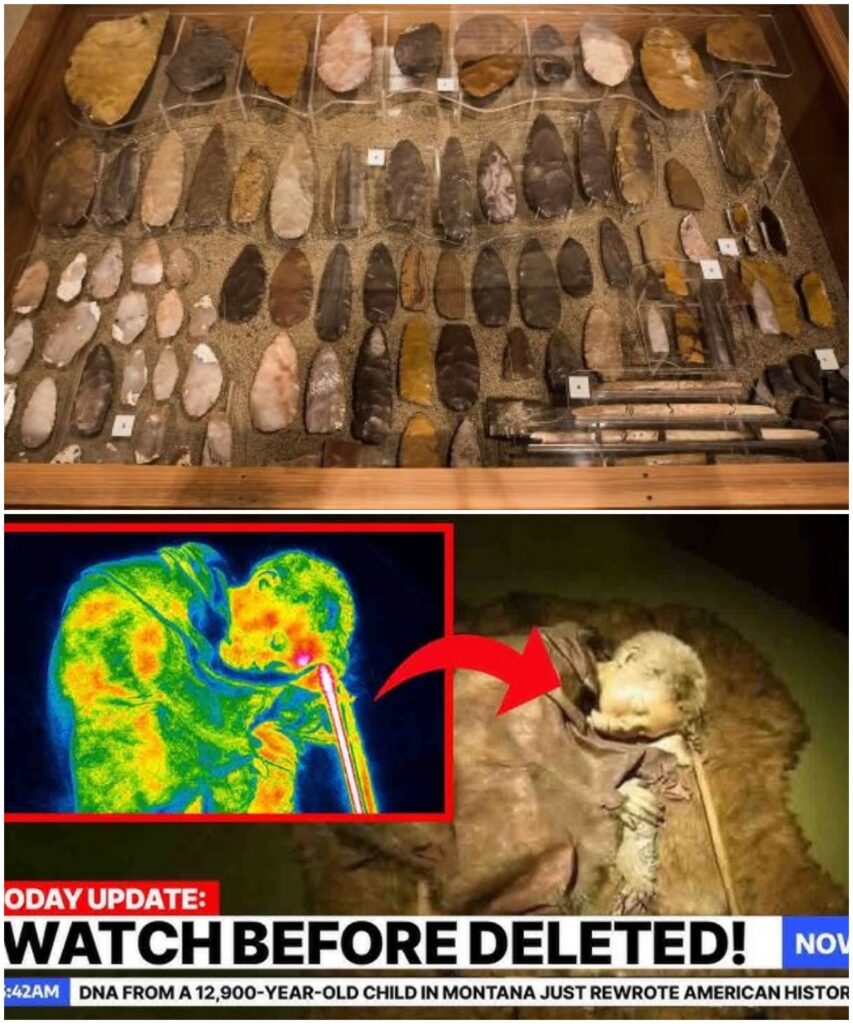
This was the Anzick child, named after the ranch where his tiny grave was found. Nestled beneath layers of rock and sediment, his remains were surrounded by stone spear points and ochre-stained tools, unmistakably linked to the Clovis culture — long considered the first widespread civilization in North America. For decades, the Clovis people were an archaeological mystery: master hunters, toolmakers, and nomads who appeared suddenly across the continent around 13,000 years ago, then vanished almost as quickly.
But the mystery deepened in 2014, when scientists managed to extract and sequence DNA from the child’s fragile bones — the oldest complete genome ever recovered in the Americas. What they found was nothing short of revolutionary.
The genetic code of this ancient infant revealed a direct link to nearly all Indigenous peoples of North and South America. Every living Native community, from the Arctic tundra to the Amazon basin, shared traces of his lineage. It was as if the Anzick child’s DNA was the spark from which the entire human story of the Americas had ignited.
For decades, scientists debated how the first people arrived here. The traditional theory — that small groups crossed a land bridge from Siberia to Alaska during the last Ice Age — was widely accepted, but not everyone agreed on the timing, routes, or origins. Some suggested migrations from Europe, others from the Pacific Islands. But this single genome cut through the noise.
The Anzick child’s DNA proved that the first Americans came from a single ancestral population that had split from East Asians more than 23,000 years ago, likely surviving for millennia in the frozen isolation of Beringia — the landmass that once connected Siberia and Alaska. When the glaciers began to melt, that population surged south, spreading across an empty continent with astonishing speed.
Within just a few thousand years, their descendants reached Patagonia. They crossed mountain ranges, deserts, and ice fields, adapting to every climate on Earth’s longest north-south landmass. This wasn’t just a migration — it was one of the most rapid human expansions in history.
Even more remarkable, the DNA revealed something unexpected: the Clovis people weren’t a dead end. For years, archaeologists assumed that when their distinctive stone technology disappeared around 12,600 years ago, so did they. But the genome told another story — the Clovis child’s lineage lived on, weaving through generations and bloodlines that still exist today.
In other words, Indigenous peoples of the Americas aren’t distant descendants of Clovis — they are Clovis. The culture didn’t vanish; it evolved. The tools changed, but the people remained.
This discovery also helped dismantle a darker chapter in archaeology — one that too often treated Indigenous history as a puzzle to be solved rather than a heritage to be honored. When the DNA results were published, many Native American leaders were initially wary, recalling a long history of research done without consent. But after careful collaboration with the Crow Nation and other tribal representatives, the Anzick child’s remains were respectfully reburied, returning him to the land that had kept his secret for nearly 13 millennia.
That act of reburial was more than symbolic — it was historic. It bridged science and spirit, showing that DNA doesn’t just tell us where we come from; it tells us how we are connected. The genome of one ancient child had unified a continent’s story — proving that every Indigenous group in the Americas shared a single, ancient root.
And there was one final twist: the Anzick child’s DNA showed faint genetic echoes linking back to peoples of Siberia and Northeast Asia, confirming that the first Americans were part of a much larger Ice Age migration that reshaped the human map of the world.
So what does it all mean?
It means the story of America didn’t begin 500 years ago, or even 5,000. It began over 13,000 years ago, when a small band of explorers crossed a frozen bridge and became the first Americans. It means that the Indigenous peoples of the Americas are not “newcomers” to this land — they are its oldest storytellers, its first architects, its first dreamers.
And all of that — the entire epic of human migration, resilience, and survival — lay hidden in the bones of a single child.
Today, the Anzick site in Montana is quiet again. Grass sways in the wind, and the earth that once held him has been sealed, sacred once more. But beneath that soil, the echoes of his story remain — a whisper across time reminding us that history isn’t written in books or myths alone.
Sometimes, it’s written in our very blood.