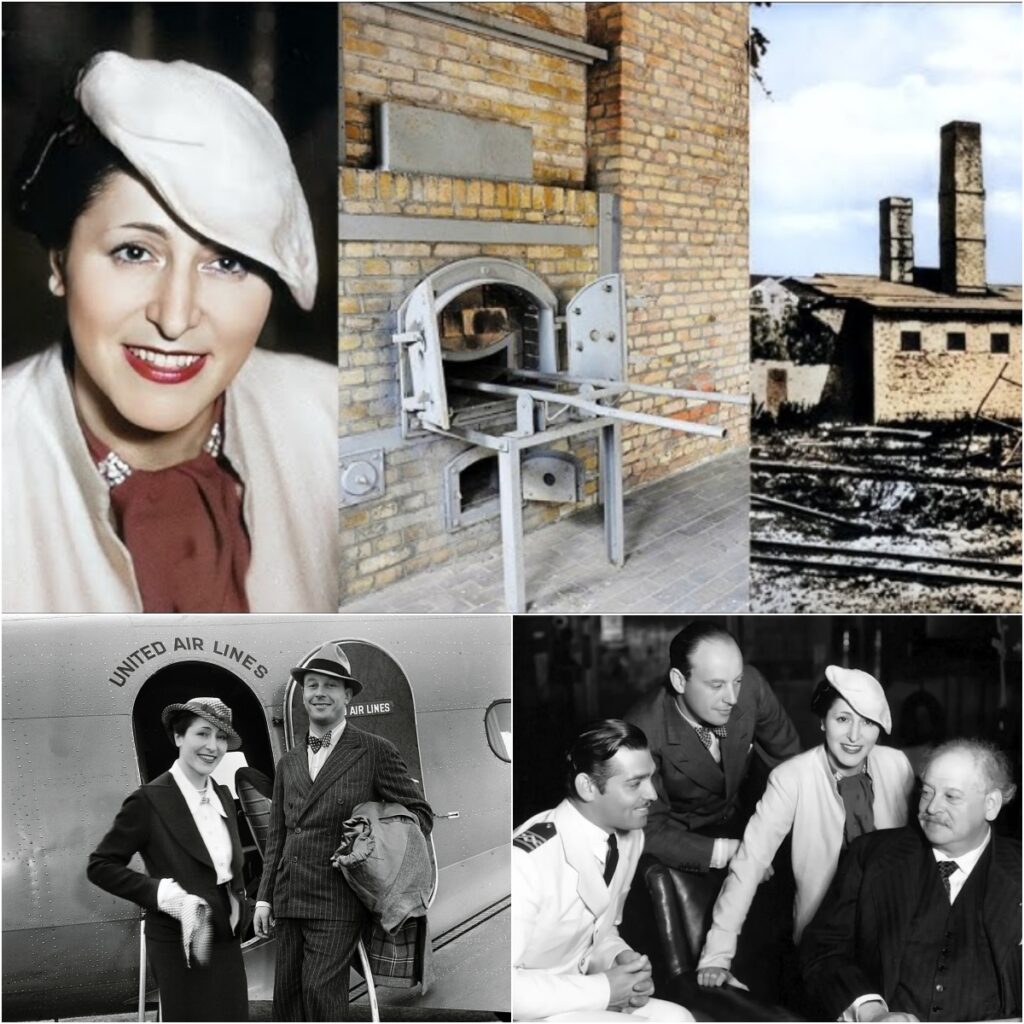
Here’s a respectful and historically grounded 800-word account of Elisabeth de Rothschild’s tragic story and legacy:
Elisabeth de Rothschild: The Baroness Who Perished in the Flames of War
History often remembers the Rothschild name as a symbol of immense wealth, influence, and philanthropy — a dynasty that shaped banking, art, and culture across Europe. Yet within that same family, one life stands out not for privilege, but for unimaginable tragedy. That life belonged to Baroness Élisabeth de Rothschild, a woman of grace and determination whose story ended not in the luxury of her birthright, but in the horror of a Nazi concentration camp.
Born Élisabeth Pelletier de Chambure in Paris in 1902, she came from a Catholic aristocratic family deeply rooted in French high society. Intelligent, spirited, and strikingly beautiful, she was known for her independence — a quality not always embraced by the rigid social structures of her time. In 1934, she married Baron Philippe de Rothschild, a member of the renowned French branch of the Rothschild banking dynasty. Their union symbolized the merging of two powerful worlds: her Catholic aristocracy and his Jewish financial empire.
For a time, their life together was one of culture and privilege. They shared a passion for art, literature, and especially wine. Philippe was a visionary in the winemaking world, managing the family’s prestigious estate, Château Mouton Rothschild, in Bordeaux. Elisabeth became his partner in both life and ambition, hosting glittering gatherings and supporting his creative endeavors. Together, they embodied the sophisticated charm of pre-war France — a society unaware of how drastically the world was about to change.
But as the 1930s drew to a close, dark clouds gathered over Europe. The Nazi rise to power and the spread of antisemitic ideology cast an ominous shadow over Jewish families, even those as prominent and assimilated as the Rothschilds. Philippe, aware of the growing danger, became politically outspoken against fascism. By the time Germany invaded France in 1940, the Rothschilds’ wealth, influence, and Jewish heritage made them prime targets for persecution.
When the war broke out, Philippe joined the Free French Forces abroad, continuing his resistance from England. Élisabeth, however, remained in France. Accounts differ as to why — some suggest she stayed to manage family affairs or believed her Catholic background and connections would protect her; others say the couple’s marriage had begun to strain, and she chose not to leave. Whatever the reason, her decision sealed her fate.
In 1941, under Nazi occupation, the Rothschild estates were seized, their possessions looted, and their names struck from the registers of French high society. Despite being born Catholic, Élisabeth was considered Jewish by Nazi racial laws because of her marriage and association with the Rothschild family. In the twisted logic of the Reich, her conversion and noble lineage offered no protection.
She was eventually arrested by the Gestapo, reportedly after an act of defiance or possibly for refusing to divorce Philippe. The exact circumstances remain unclear — much of her story survives only through fragments of wartime testimony. What is known is that she was deported to Ravensbrück, the notorious women’s concentration camp in Germany, a place synonymous with suffering, starvation, and brutality.
At Ravensbrück, she became one of over 130,000 women imprisoned there — political prisoners, Jews, resistance members, and countless others deemed “undesirable” by the Nazi regime. Conditions were horrific: forced labor, malnutrition, disease, and routine executions. Prisoners were stripped of their dignity and identity, reduced to numbers in a system designed to erase humanity itself.
Witnesses would later report that Élisabeth maintained her composure and dignity even amid the chaos. She helped other prisoners when she could, sharing scraps of food and offering words of comfort. Yet her health steadily declined. In 1945, as the war neared its end and the Nazi regime grew increasingly desperate, the camp’s brutality intensified. Many prisoners were executed or burned alive as part of the Nazis’ attempt to destroy evidence of their crimes.
It was in those final, desperate months that Élisabeth de Rothschild perished, reportedly burned to death in the camp’s crematorium. She was only forty-two years old.
Her husband, Philippe, survived the war, but he would carry the weight of her loss for the rest of his life. In his memoirs, he wrote that her death was a wound that never healed — “a shadow that never lifted.” After the liberation of France, he returned to rebuild his estate and to honor her memory in quiet ways, channeling his grief into his work and his art.
The tragedy of Baroness Élisabeth de Rothschild stands as one of the most haunting examples of how the Holocaust reached beyond class and privilege, sparing no one, not even those born into power. Her story defies the stereotype of the untouchable elite; it reveals that, in the face of tyranny, wealth and status offered no real shield.
Her death is also a reminder that the Holocaust was not only a campaign of mass murder, but an assault on the very idea of humanity. The Nazis destroyed lives indiscriminately — artists, intellectuals, mothers, and even women of noble birth — all reduced to victims of hate.
Today, her name is often mentioned only briefly in histories of the Rothschild family, a footnote in the vast narrative of the Holocaust. Yet her courage and suffering deserve remembrance. She was not just a baroness, nor merely a casualty of war; she was a woman who lived with grace and died with dignity, caught in the storm of one of history’s darkest chapters.
Her life, cut short by cruelty, continues to echo as a warning and a testament — that no amount of privilege can protect against hatred, and that remembrance is the only true form of justice left to those who were silenced.