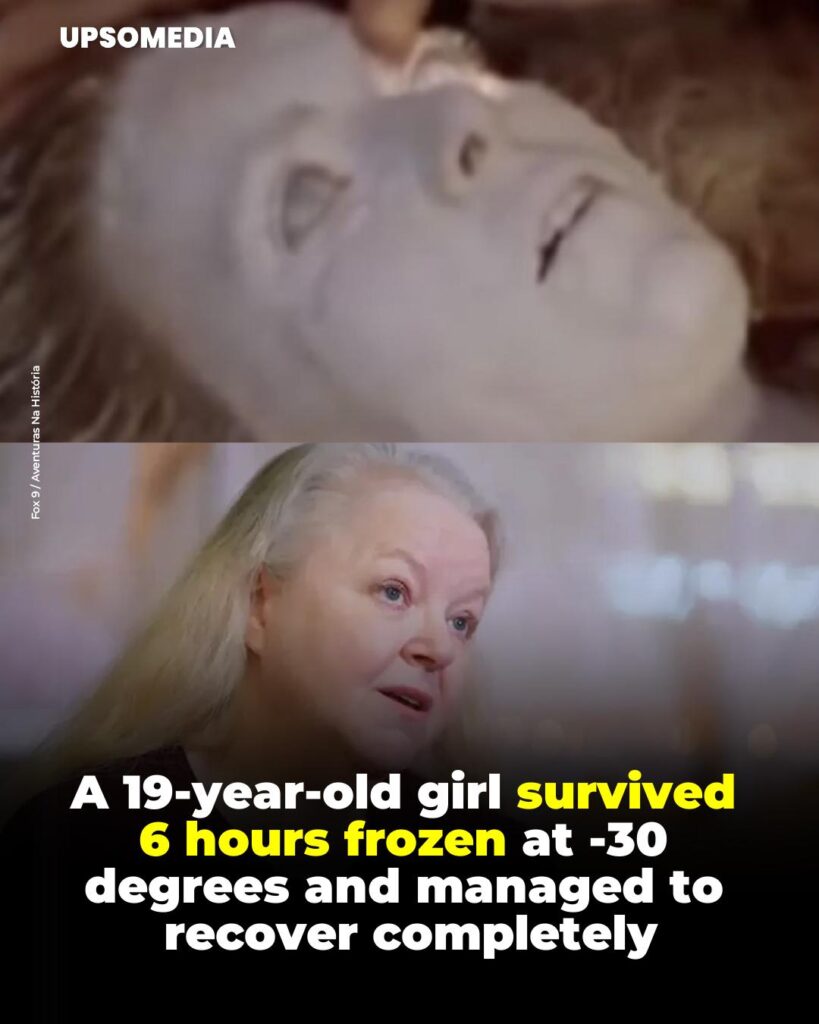
It was the winter of 1980 in the small, snowbound town of Lengby, Minnesota — a place where the cold could cut through even the thickest layers of clothing, and where temperatures routinely plunged far below zero. On one of those bitter nights, 19-year-old Jean Hilliard became the subject of one of the most miraculous survival stories in modern medical history — a tale so astonishing that even decades later, doctors still struggle to fully explain it.
Jean was a bright, outgoing young woman, known for her easy laughter and small-town warmth. That December evening, she had been driving home after visiting a friend. The roads were slick with ice, the air biting with subzero chill. Her car, an old Ford LTD, hit a patch of ice and skidded off the road into a ditch. The engine stalled, leaving her stranded in temperatures nearing -30°C (-22°F).
Dressed in winter clothing but without heavy gear for the deadly cold, Jean knew she couldn’t stay in the car. She decided to walk to a nearby farmhouse belonging to her close friend, Wally Nelson, just a few kilometers away. It was the kind of choice most people would make instinctively — get to shelter, find help. But as the night deepened and the temperature plummeted further, every step became harder. The freezing air bit at her lungs, and the snow turned the short distance into a brutal ordeal.
After several hours of struggling through the snow, Jean collapsed just meters from Wally’s front door. She was so close to safety that her footprints nearly reached the porch. But exhaustion and cold overtook her. She fell face-first into the snow, unconscious. The night pressed on in silence, the wind sweeping over her motionless body as the temperature continued to drop. For six long hours, Jean lay there, completely frozen.
When Wally discovered her early the next morning, he thought she was dead. Her skin was gray, her eyes open but glassy, her body frozen stiff as a board. “I grabbed her by the collar,” he later recalled, “and she was as stiff as a log — like she’d been in a deep freeze all night.” Yet something — perhaps instinct, perhaps hope — made him rush her to the hospital instead of calling the coroner.
At the Fosston Municipal Hospital, doctors were astonished. Jean’s skin was frozen solid; they couldn’t even insert a thermometer to measure her temperature. Her limbs were unbendable, and her pulse was undetectable. By all medical definitions, she appeared lifeless. Yet her pupils reacted faintly to light — a tiny sign of life that spurred the doctors to try to save her.
They began a gradual rewarming process, knowing that sudden exposure to heat could cause fatal shock. Electric blankets were wrapped around her, and warm, humidified oxygen was administered. Slowly, as her body temperature rose, the impossible began to happen. After two to three hours, her body started to tremble slightly. Then, to the astonishment of everyone in the room, her heart began to beat again.
The doctors and nurses couldn’t believe what they were witnessing. One of them reportedly said it felt like “watching someone come back from the dead.” As Jean’s body warmed, her color returned, and within hours, she regained consciousness — confused, but miraculously alive.
Even more astonishing was what came next. Despite being frozen for six hours in lethal temperatures, Jean showed no signs of permanent damage. There was no brain injury, no organ failure, no need for amputations — outcomes that are nearly inevitable in severe hypothermia cases. Apart from some minor frostbite on her toes, she was completely fine. Within weeks, she was walking, talking, and laughing again, as though nothing extraordinary had happened.
Doctors described her recovery as “beyond explanation.” At the time, medical science had little understanding of how the human body could survive such extreme freezing. But Jean’s case helped expand the study of hypothermic preservation, a phenomenon where the body’s metabolic rate drops so low in cold temperatures that it enters a state of suspended animation. In this state, the organs — including the brain — require very little oxygen, allowing survival far beyond normal limits.
Jean herself was humble about her near-death experience. When reporters flooded her with questions, she downplayed the drama. “It’s just a miracle, I guess,” she said simply. “I was lucky. That’s all.”
In the years that followed, her story became a medical marvel — cited in textbooks, documentaries, and research papers. Her survival challenged assumptions about the limits of the human body and inspired advances in emergency medicine, particularly in how hypothermic patients are treated. Before her case, many victims found “frozen” were presumed dead; after Jean, doctors learned that sometimes, as the saying goes, “you’re not dead until you’re warm and dead.”
Today, Jean Hilliard’s name stands as a symbol of resilience — proof that even in the most hopeless circumstances, the human spirit and body can defy the odds. Her story continues to inspire not just scientists and physicians, but anyone who has ever faced overwhelming hardship.
That night in Minnesota remains a reminder of both the cruelty and mercy of nature. The same cold that nearly killed her also saved her — by slowing her body’s functions just enough to protect her until help arrived. It was a delicate balance between death and survival, between the frozen stillness of despair and the warmth of rebirth.
When asked years later how she viewed that night, Jean said softly, “I guess God wasn’t ready for me yet.” And perhaps that’s the simplest explanation of all — that in a world where logic fails, what remains is faith, endurance, and the mystery of a miracle.