A mother lay in her coffin, serene and pale, surrounded by mourners who had gathered to say their final goodbyes. The air was thick with grief, punctuated by quiet sobs and the gentle rustle of black attire. Among the mourners was her youngest child, a baby too small to fully understand the enormity of the loss. Yet somehow, he seemed to sense it — an instinct older than reason, a connection deeper than words. The scene was both tender and macabre, an image that would linger in the minds of all who witnessed it.
The baby had been cradled in his grandmother’s arms, restless and fidgeting, unaware of the weight of sorrow surrounding him. Every so often, he would squirm, reaching out instinctively with tiny hands, as if trying to touch something just beyond his grasp. His grandmother, gently rocking him back and forth, felt the child’s unease. She whispered soothing words, hoping to calm him, but his small body continued to tremble, a subtle yet undeniable signal that he felt something the adults could not.
Realizing he needed someone stronger, she passed him to his father, who held him close to his chest. Instantly, the baby’s trembling intensified, a soft shiver running through him. The father, overwhelmed with grief and concern, looked down into the child’s eyes and felt an unspoken understanding pass between them — a bond that transcended age, experience, and reason. The baby’s gaze, bright and unyielding, seemed fixed on the coffin in front of him. There was a clarity in his expression, a knowing, that made everyone watching hold their breath.
Without warning, the child wriggled free, almost purposefully, from his father’s arms. His tiny feet found purchase on the polished floor, and with astonishing determination, he crawled forward. The crowd fell silent. Some gasped softly, unsure of what was unfolding. Others watched in stunned awe, tears welling in their eyes, caught between heartbreak and amazement. The baby approached the coffin, as though drawn by an invisible thread, as though he could sense the presence of the mother he had never fully known but had always felt.
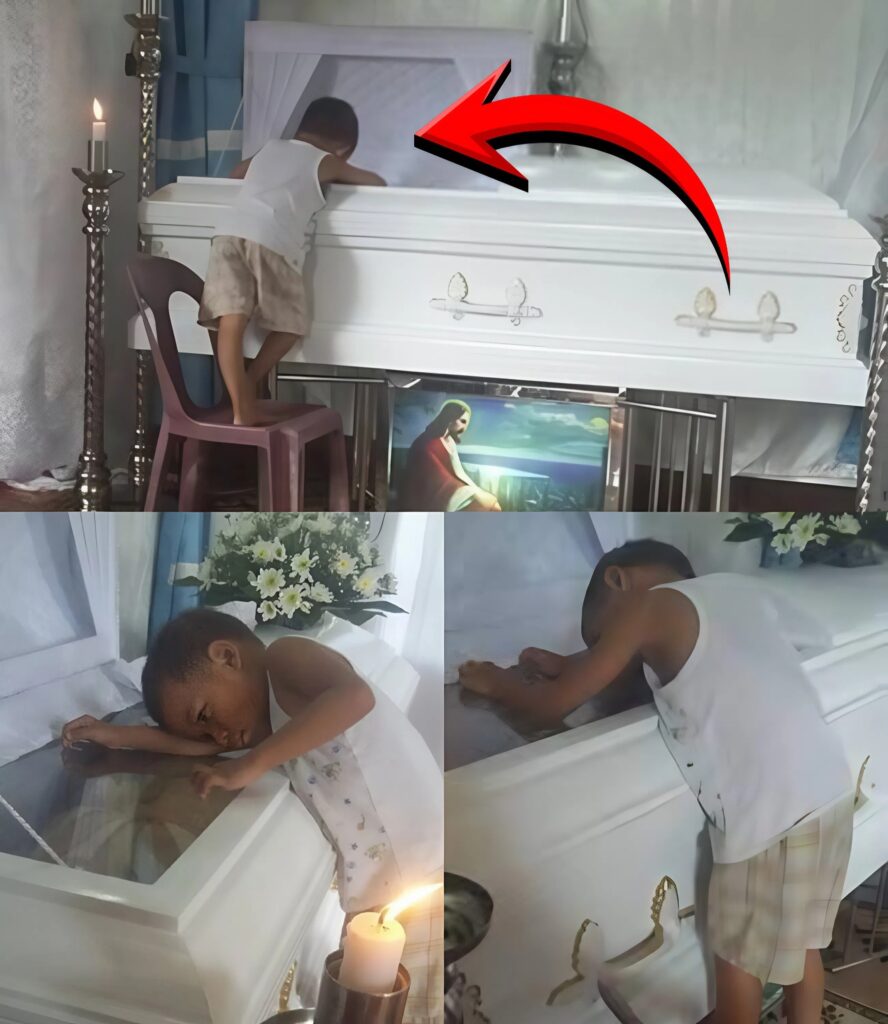
He paused at the edge of the coffin, tiny hands gripping the wooden frame. For a moment, the world seemed to hold its breath. The baby looked up at his father, then back at the mother inside, his eyes wide, searching, and strangely understanding. Then, with a courage that seemed far beyond his months, he began to climb. Hands and knees worked in perfect coordination, as if guided by an instinct no one could explain. The room was filled with a profound, almost sacred silence, the kind that happens when ordinary life meets the extraordinary.
Once atop the coffin, he leaned over gently, resting his small forehead against his mother’s chest. The act was simple, tender, and heart-wrenching. He did not cry. He did not scream. He simply stayed there, close to her, as if drawing warmth from the memory of her heartbeat, a heartbeat that no longer pulsed but whose presence lingered in every corner of that room. The mourners wept openly, moved by the purity of a love so untainted by understanding, so raw in its innocence.
The father held his breath, tears streaming down his face, unsure whether to intervene or allow this fragile moment of connection to continue. The baby’s tiny hand rested over his mother’s chest, and in that touch, there was a communication older than language — a love that needed no words, a grief that needed no explanation. Every person present felt it, an almost tangible energy that filled the room, bridging life and death with a fragile, trembling thread of devotion.
It was as though the child could feel something the adults could not — a whisper of the mother’s essence, a memory embedded in the very air, a presence that transcended the limits of the human body. He stayed there for what seemed like minutes, though time itself had become irrelevant. His gentle touch, the way his tiny chest pressed against hers, spoke of comfort, longing, and connection. It was a moment that no one could have predicted, and yet, somehow, it felt inevitable.
Eventually, his father lifted him down, cradling him close once again. The baby’s eyes lingered on his mother for one last long, unspoken farewell. And though he may never fully understand the depth of the moment, the people present did. They understood the power of a bond unbroken by death, the purity of instinctive love, and the profound courage of a child reaching out across the divide.
The funeral continued, but nothing could erase what had happened. That small, trembling child had reminded everyone of something larger than grief itself: that love endures beyond life, that connection is never truly severed, and that sometimes, the smallest hands can offer the greatest comfort. In that quiet, tear-streaked room, the baby had taught a lesson none of the adults would ever forget — that even in death, the presence of a loved one can still be felt, still be touched, and still be honored in the simplest, most extraordinary of ways.
Even after the coffin was lowered and the final goodbyes were said, the image remained — a tiny forehead pressed gently against a mother’s chest, a fragile but unbreakable bond that had defied loss and touched the hearts of all who witnessed it. It was a moment of sorrow, yes, but also of hope, of connection, and of love so pure that it left everyone in tears, forever changed by the quiet courage of a little baby who reached for what he knew was never truly gone.