The Father Who Wouldn’t Let Go — A Love Buried Beneath the Mud 💔
On December 15, 1999, Venezuela faced one of the darkest moments in its history — the Vargas Tragedy, a catastrophe born from nature’s fury and human vulnerability. Torrential rains pounded the country’s northern coast for days, unleashing deadly floods and landslides that tore through entire communities. Within hours, neighborhoods were gone — homes buried, lives erased, and the once-bustling coastal state of Vargas transformed into a sea of mud and ruin.
Amid the chaos and destruction, one story would rise from the devastation to capture the world’s heart — a story not of survival, but of love, courage, and sacrifice that endures beyond death.
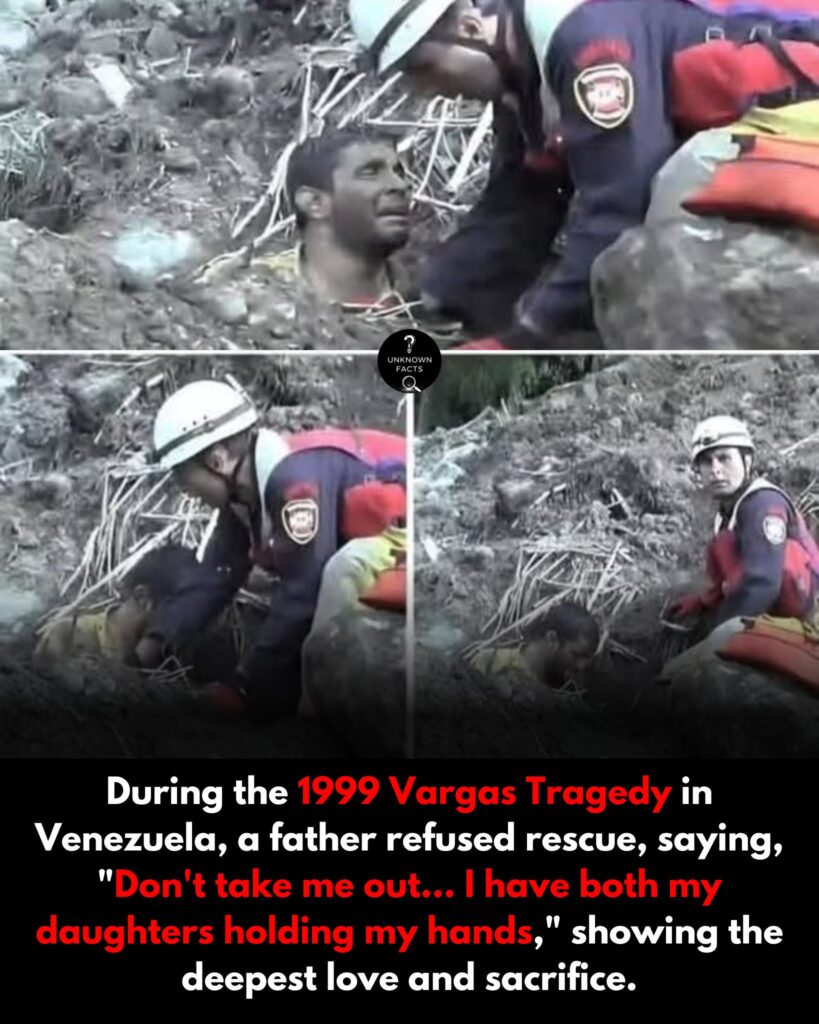
As rescuers combed through the thick, suffocating mud, they came upon a man half-buried beneath the wreckage — a father clutching the hands of his two daughters. The rescuers, exhausted but determined, rushed to pull him free. Yet when they reached him, the man shook his head weakly and whispered words that would echo through history:
“Don’t take me out… I have both my daughters holding my hands.”
His voice was calm, almost serene, despite the nightmare surrounding him. His daughters — still unseen under the heavy mud — were already gone. But he refused to let go, clinging to them with a love that defied death itself. The rescuers knew the truth, but the father did not want release; he wanted to remain where his daughters lay, united in their final embrace.
It was an act of pure, selfless devotion, a moment that embodied what it means to love beyond fear, beyond reason, beyond survival. The rescuers, moved to tears, could do nothing but honor his wish. Hours later, when the landslide shifted again, all three were swallowed completely by the earth — a family together until the end.
This heartbreaking scene became a symbol of the Vargas Tragedy, one of the most devastating natural disasters in Latin American history. Continuous rainfall over several days triggered massive landslides along the Venezuelan coast, particularly in Vargas State. The scale of destruction was unimaginable — over 8,000 homes destroyed, with entire towns erased from the map. The exact number of victims will never be known, but estimates range between 10,000 and 30,000 lives lost.
Survivors described the horror: torrents of mud, rock, and debris cascading down the mountains with unstoppable force, burying families as they slept. Streets turned into rivers of sludge; the night sky glowed orange with lightning as the mountains collapsed into the sea. Within hours, communication lines were cut, and roads vanished beneath tons of earth. Rescuers had to climb over broken rooftops and uprooted trees to reach trapped residents — often too late.
But amid the overwhelming despair, countless stories of bravery and love emerged. Mothers shielding their children, neighbors forming human chains to pull strangers to safety, and rescuers digging with bare hands through the muck, refusing to give up. And yet, no story captured the heart of a nation — and the world — quite like that of the father and his two daughters.
His simple, devastating words — “Don’t take me out…” — transcended tragedy. They spoke to the unbreakable bond between a parent and child, to the instinct to protect, to hold, to stay — even when survival is no longer possible. In that moment, surrounded by destruction, he became a symbol of humanity at its purest: love unyielding, love eternal.
In the years since, the Vargas Tragedy has remained etched in Venezuela’s collective memory. Annual commemorations honor those lost, and survivors continue to rebuild, carrying memories of those who never returned. The government has since developed new infrastructure and disaster response systems to prevent another catastrophe of such magnitude — but the emotional scars remain.
For many, the father’s final act stands as the soul of that terrible day — a reminder that even in the deepest darkness, love can shine with unearthly light. His story has been retold in schools, documentaries, and memorial services, not for its horror, but for its humanity.
Because in a moment when everything was lost — when the ground itself turned against its people — one man’s choice showed the world the true measure of devotion. He could have lived, but he chose to stay, his hands bound not by the mud, but by love itself.
As time moves forward, and new generations learn about the Vargas disaster, his story endures as a timeless testament to what makes us human — the capacity to love beyond our own lives, to hold on even when the world around us falls apart.
In the end, his words echo softly through history, carried by the winds that still whisper through Venezuela’s valleys:
“Don’t take me out… I have both my daughters holding my hands.”
A father’s last promise — and a love that will never let go. ❤️