Cyborg — The Boy Who Refused to Stop 🦿💪
They call him Cyborg, a nickname that sounds like something out of a comic book — until you meet him. There’s no armor, no steel mask, no futuristic weapons. Just a boy named Mateus, whose quiet determination has turned pain into progress, and whose story blurs the line between human endurance and mechanical strength.
Mateus was born with one leg shorter than the other, a condition that made walking difficult and running nearly impossible. Doctors told his parents that he might never move like other children — that he’d always have a limp, always struggle to keep balance. But Mateus, even as a child, refused to accept a life defined by limits.
From the moment he could stand, he wanted to run — to feel wind, speed, and freedom. And so began a journey that would test not just his body, but his will.
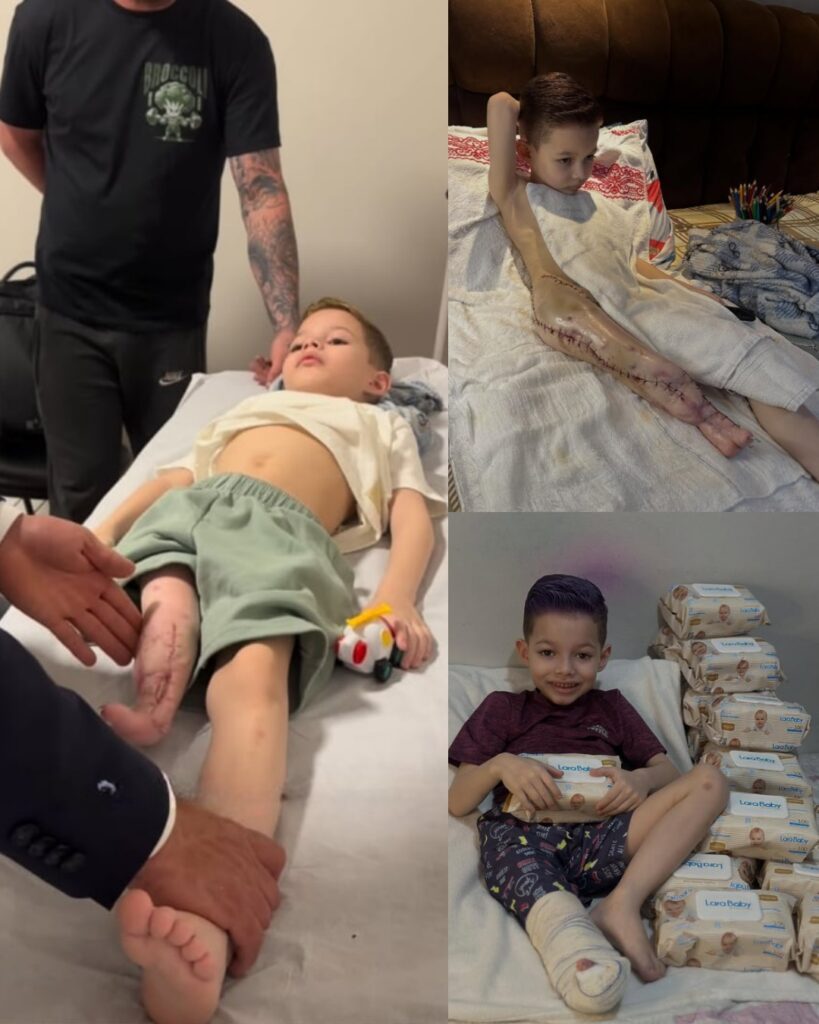
Through years of consultations, surgeries, and rehabilitation, Mateus learned to endure what most could not imagine. The key to his transformation came through a process called limb-lengthening surgery — a procedure as remarkable as it is excruciating. Surgeons broke the bone in his shorter leg and inserted metal rods and pins, devices designed to gradually stretch the bone tissue.
Each day, his doctors — and sometimes Mateus himself — would adjust the device by a fraction of a millimeter, allowing new bone to form in the growing gap. It was a slow, relentless march toward symmetry. The pain was sharp, constant, and exhausting. Every stretch burned, every step felt like walking on fire. But Mateus never quit.
He learned to celebrate progress not in leaps, but in millimeters.
Every new centimeter gained wasn’t just physical — it was emotional, proof that hope could be measured and earned through endurance.
So far, Mateus has gained over ten centimeters, each one carved out of hardship and courage. His scars tell a story written in metal and determination — a map of battles fought and won on the operating table and in the quiet hours of recovery.
When people ask him about the pain, about the rods still holding his leg together, he doesn’t shy away. He looks down at the thin white lines crossing his skin — marks of struggle, symbols of strength — and smiles.
“They hurt,” he says, “but they made me stronger.”
And he means it.
Behind that smile is a spirit forged in patience and resilience. His journey is not over — another surgery awaits, another round of adjustments, another climb up the mountain of healing. But Mateus doesn’t dread it. He dreams of running, of feeling both legs strike the ground with equal power, of racing into the future on his own terms.
Because for him, strength has never been about perfection. It’s about refusal — refusal to give up, to surrender, to be defined by the odds.
Where others see scars, Mateus sees proof.
Proof that every setback can be turned into momentum.
Proof that pain, when faced with courage, can become a form of power.
His nickname, Cyborg, started as a joke — a nod to the metal in his leg. But over time, it became something more: a symbol of his transformation. He isn’t half machine, half human. He’s entirely human, but with a heart and will stronger than steel.
Doctors now use his case as an example of what’s possible when medicine meets perseverance. His parents, once terrified by uncertainty, now call him their miracle in motion.
And Mateus? He just wants to run. Not to prove the doctors wrong — but to prove to himself that he was right to believe all along.
One day soon, when the rods are gone and the scars are all that remain, he’ll take off down a track or a field, both legs striking the ground evenly. And in that moment — fast, free, unstoppable — he’ll no longer be the boy who was told he couldn’t. He’ll be the man who showed that you can rebuild yourself, one millimeter at a time.
Because strength isn’t born from perfection.
It’s built from persistence.
And Mateus — the boy they call Cyborg — has already proven that some heroes don’t wear capes.
They wear scars. 🦾🔥