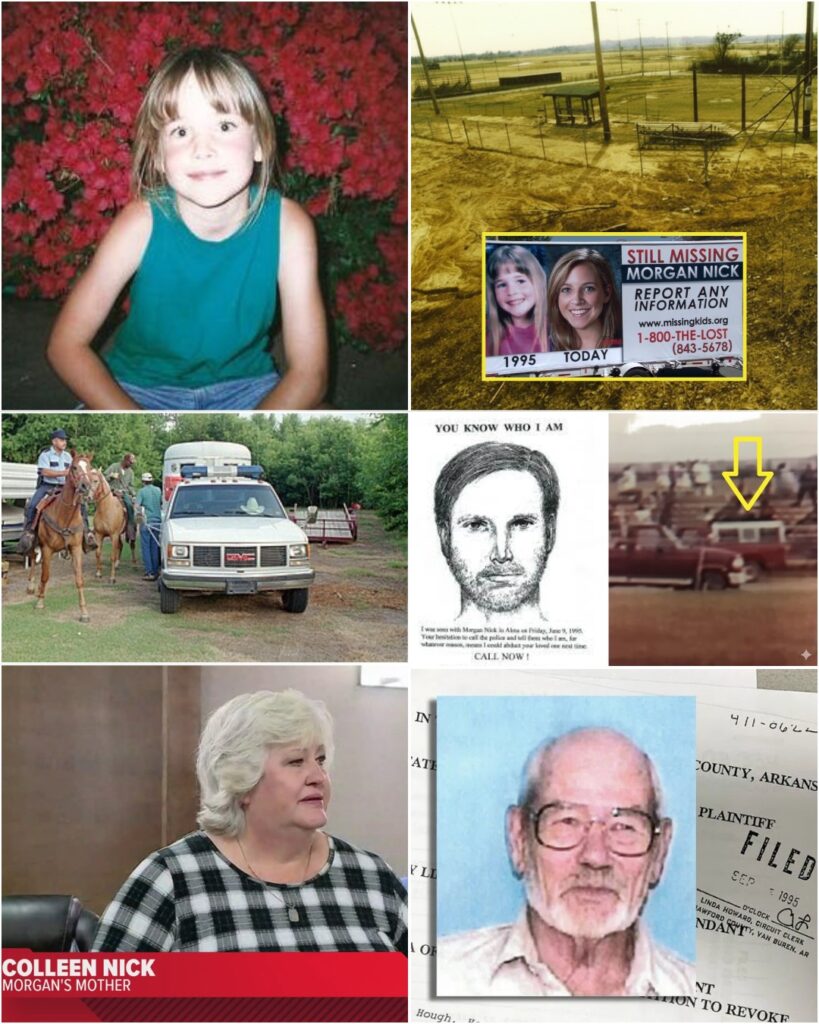
💔 The 60 Seconds That Stole a Lifetime: The Morgan Nick Case 💔
June 9, 1995 — a warm summer evening in Alma, Arkansas. The kind of night that smells like popcorn, fresh-cut grass, and childhood. Families filled the bleachers at a Little League baseball game, their cheers echoing across the field. Among them was six-year-old Morgan Nick, a bright little girl with blonde hair, blue eyes, and a smile that could light up a room.
She was chasing fireflies with friends near the parking lot — just a few steps away from her mother, Colleen Nick, who watched proudly from the stands. It was supposed to be a simple night — a game, some laughter, a few mosquito bites, and memories made.
Then came the moment.
Colleen looked away — maybe to cheer, maybe to talk to another parent. Just 60 seconds. That’s all it took.
When she turned back, Morgan was gone.
At first, there was confusion — a mother’s disbelief. Maybe she’d wandered off. Maybe she’d gone to the concession stand. But minutes turned into hours, hours into days. Witnesses remembered seeing a red pickup truck parked near the field. They recalled a man watching the children, someone unfamiliar. But it was 1995 — long before security cameras were everywhere, before cell phones captured everything.
All investigators had was a vague description, a color, and a mother’s desperation.
Colleen Nick refused to give up.
She plastered Morgan’s face on posters, billboards, and milk cartons. She built a foundation — The Morgan Nick Foundation — to help other missing children and their families. She became a voice for the voiceless, turning her grief into relentless advocacy. Every year, she spoke Morgan’s name on national television, reminding the world that her little girl was still out there, somewhere.
“I always believed my daughter would be found,” she said. And she meant it.
For nearly 30 years, Colleen carried that hope through endless leads, false sightings, and sleepless nights. Each phone call brought both dread and faith — maybe this was it, maybe this was the moment she’d been waiting for.
Then, in 2024, science caught up to the mystery.
Breakthrough DNA technology, the kind that could trace ancestry and solve cold cases with microscopic evidence, finally opened a door long closed. Investigators re-examined the case file — and inside was one piece of evidence that had been stored for decades: a single blonde hair recovered from the red pickup truck witnesses had described all those years ago.
This time, the test worked.
One strand of hair. One match. One name.
After three decades, police called Colleen. They had found him — the man who took her little girl.
Colleen prepared herself for the truth. She imagined what she might feel — relief, closure, maybe even peace. She braced herself for the story of what happened that night.
But when investigators told her what they’d found, her world broke all over again.
The man identified through DNA had died years earlier. But that wasn’t the worst part. It was what he did just two months after Morgan disappeared — another child abducted, another life destroyed, another family left in ruins.
He had been right there, hiding in plain sight, moving from town to town. He’d been arrested years later on unrelated charges, his crimes buried under aliases and sealed files. By the time the truth emerged, he had already taken his own life — taking the answers with him.
Forensic teams searched his former properties, digging through acres of land, searching lakes, combing through evidence. But Morgan’s body was never found.
There would be no reunion, no homecoming, no final goodbye.
And so, even with a name, the case could not truly be closed.
The man responsible for one of the most haunting child abductions in America could no longer be punished. Justice came too late — a lifetime too late.
When reporters asked Colleen how she felt, she paused — her voice steady, but her eyes heavy with thirty years of heartbreak.
“I thought knowing would help,” she said quietly. “But the truth… the truth is worse than not knowing at all.”
Because the truth revealed not only what happened to her daughter, but the depth of evil that walked beside them that night. It revealed how a mother’s 60-second glance — the smallest, most human moment — could unravel an entire world.
And yet, through the heartbreak, Colleen still refuses to let Morgan’s story end in darkness.
She continues her mission — helping other parents find their missing children, pushing for better investigations, keeping hope alive where it once seemed impossible. She says Morgan’s light still guides her.
“She’s still my little girl,” Colleen says. “And she always will be.”
Thirty years after that summer night, the story of Morgan Nick remains one of loss, love, and unshakable strength. A reminder that evil can hide behind ordinary faces — and that a mother’s love, even in the face of the impossible, never dies.
🕊️ Sixty seconds changed everything. But thirty years of love kept her memory alive.