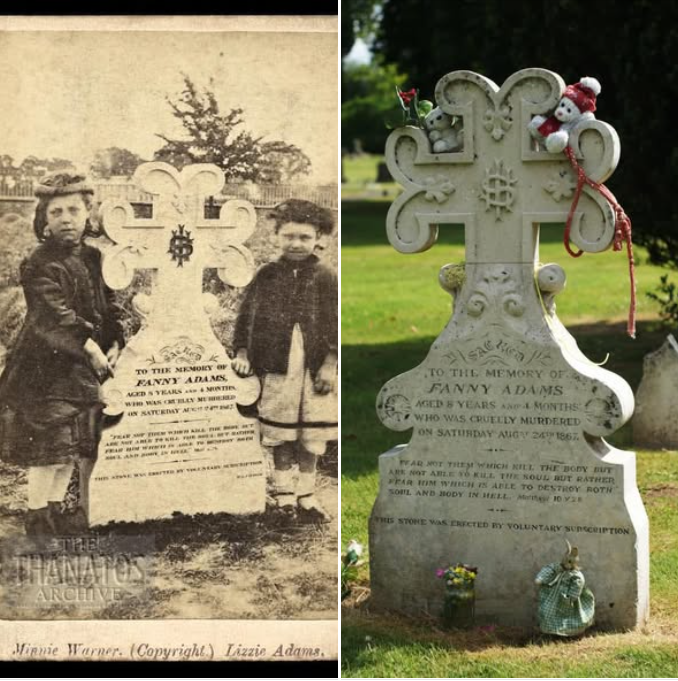
The Murder of Fanny Adams: The Crime That Shocked Victorian England
It was a bright summer afternoon on August 24, 1867, in the quiet market town of Alton, Hampshire, England. Eight-year-old Fanny Adams, a cheerful and lively little girl, set out to play with her younger sister Lizzie and their friend Minnie Warner. The three girls walked together through the sunlit meadows, giggling as children do, unaware that this day would end in one of the most shocking and gruesome murders of the Victorian era — a crime so horrifying that it would forever etch Fanny’s name into England’s dark history.
Fanny was known around Alton as a spirited, kind-hearted child — blonde-haired, bright-eyed, and always full of energy. Her father, George Adams, was a laborer, and her mother Harriet looked after the home and their large family. Life was simple, and despite the hardships of working-class existence, the Adams family was close-knit and content. That afternoon, when Fanny and her companions ran out to play near Flood Meadow, there was no reason to fear danger. Alton was a small, safe community where neighbors knew one another — or so everyone believed.
Around 1 p.m., as the girls wandered near a field behind Tanhouse Lane, they encountered a man named Frederick Baker, a 29-year-old clerk at a local solicitor’s office. Baker was well-dressed, polite, and seemingly harmless. He offered the girls a few halfpennies — a small treat to buy candy — and told them they could go and play further up the field. Lizzie and Minnie accepted the coins and ran off. But Fanny, perhaps trusting him too much, stayed behind.
When Lizzie and Minnie returned home later that afternoon without Fanny, Mrs. Adams immediately grew anxious. She questioned the girls, and Minnie hesitantly explained that Fanny had stayed with the man they’d met. Fear struck Harriet’s heart. She rushed to tell her husband, and within minutes, a search party was organized. Neighbors, friends, and local workers combed through the fields calling out Fanny’s name.
As the sun began to set, a man named Thomas Gates made a discovery that would haunt Alton forever. Beneath a hedge near the hop fields, he stumbled upon something too dreadful to comprehend — the mutilated remains of the missing child. Fanny’s head had been severed from her body and placed upon two hop poles, her eyes were missing, and her limbs were scattered across the field. Her small body had been hacked into dozens of pieces, as if the killer had taken pleasure in cruelty. It was an act of evil beyond imagination — even the hardened men of Alton wept at the sight.
The town descended into chaos. Rumors spread like wildfire, and people demanded justice. When police began their investigation, suspicion quickly turned toward Frederick Baker — the last man seen with Fanny. Later that evening, he was found calmly sitting at his desk, still at work in the solicitor’s office. When questioned, Baker denied harming the child but admitted he had seen her. Police, however, found disturbing evidence in his possession: two small bloodstains on his wrist and clothing, and a knife stained with what appeared to be blood.
Most chilling of all was Baker’s diary, where he had written that very day:
“Killed a young girl. It was fine and hot.”
Though some claimed it was only a morbid joke, the entry sealed his fate. Baker was immediately arrested and taken into custody. The town was furious — a mob nearly broke into the jail to lynch him themselves. The crime was so brutal that even seasoned investigators were shaken. Fanny’s remains were gathered with great care, and her mother fainted repeatedly as the pieces were identified.
The trial of Frederick Baker began on December 5, 1867, at the Winchester Assizes. Baker maintained that he had been drunk and did not remember the act, but the evidence was overwhelming. Witnesses testified that he had been seen near the field, his demeanor oddly calm. The jury deliberated for only fifteen minutes before finding him guilty of murder. The judge, in a somber tone, sentenced him to death by hanging.
Before his execution, Baker reportedly confessed his guilt to the prison chaplain, expressing remorse for what he had done. On Christmas Eve, December 24, 1867, he was hanged at Winchester Prison before a large, silent crowd. He was 29 years old — the same age as many of the young fathers who had helped search for Fanny. His body was buried within the prison walls, and the townspeople of Alton could finally breathe again, though their peace was forever broken.
Fanny Adams was laid to rest in Alton Cemetery, her small white headstone inscribed with heartbreaking simplicity:
“Sacred to the memory of Fanny Adams, aged 8 years, who was cruelly murdered August 24, 1867.”
The crime became so infamous that it entered English slang in an unexpected way. Soldiers later used the phrase “Sweet Fanny Adams” — or more crudely, “Sweet FA” — to mean “nothing at all.” It was a grim nod to the child whose life had been taken for nothing, and whose name would forever be linked to senseless loss.
Even today, more than a century and a half later, the murder of Fanny Adams remains one of the most disturbing in British history — not just for its savagery, but for what it represented: the shattering of innocence in a world that had thought itself civilized. Beneath the quiet English countryside lay the capacity for unimaginable cruelty, and in that summer of 1867, the people of Alton learned just how dark the human heart could be.
For generations, parents in Hampshire would whisper Fanny’s name to remind their children never to stray too far, and never to trust a stranger — a tragic legacy of one little girl whose laughter was stolen, but whose story would never be forgotten.