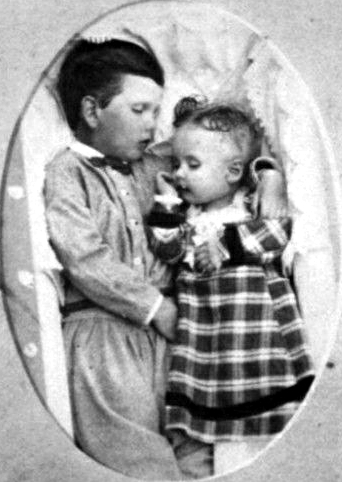
It was the winter of 1891, when grief sat heavy in parlors and mourning was measured not by tears, but by silence. In those days, sorrow was a quiet visitor, draped in black lace and candlelight, lingering in the corners of rooms where the air hung thick with loss. In one such parlor, dimly lit and shrouded in the soft veil of drawn curtains, a brother and sister lay together in a small white coffin. They were dressed as if for Sunday service—his tiny suit neatly pressed, her delicate dress trimmed with lace and ribbon. The boy, no older than five, rested with one small arm draped protectively around his sister, who could not have seen more than three winters. Their faces, pale but peaceful, bore that uncanny stillness that comes when suffering has passed and only peace remains.
Around them, the air was filled with the mingled scents of wax and flowers. Lilies, roses, and sprigs of lavender crowded the little room, their sweetness an attempt to disguise the sharp truth of death. But no fragrance could soften the ache that pulsed in the hearts of those who sat nearby. The mother, dressed in the deep black of mourning, sat motionless beside the coffin. Her hands were clasped tightly in her lap, the knuckles white, her gaze fixed on the small, motionless forms before her. Between her fingers she held a single ribbon—pink once, now faded and frayed—that had adorned her daughter’s hair. She had tied it there just days before, never knowing it would become a relic of memory rather than a token of affection.
Behind her stood the father, tall but bent slightly forward, his shoulders curved under an invisible weight. He was a man unaccustomed to fragility—his life had been one of work, of steady hands and sturdy will—but in that moment he seemed almost hollow, as if grief had scooped out his strength and left only a shell behind. His eyes did not weep; they had already wept beyond tears. He looked not at the children, but at the empty space around them, as though searching for the laughter that used to echo through the hallways, the patter of small feet that would never return.
No words passed between the two parents. There was nothing to be said. Language seemed too fragile, too small to carry the weight of what had been lost. In the hush of that room, even the air seemed to still itself, reluctant to disturb the fragile peace that death had brought. Time itself appeared to falter, its steady rhythm breaking into silence, as if the world had paused to mourn alongside them.
When the photograph was taken, it was not for vanity or display. It was a ritual of remembrance, a way to capture what the earth had taken too soon. The photographer moved quietly, his black cloth and brass camera solemn witnesses to a private sorrow. He arranged the children carefully, ensuring their hands were entwined, their faces gently turned toward the light that filtered through the curtained window. The parents stood aside, silent sentinels to the last image of their children together. The soft click of the shutter was almost imperceptible, yet it sealed forever the moment when love refused to let go, even as life slipped away.
In that image, the boy’s small arm still encircled his sister, a gesture that seemed to promise protection even in death. Their faces were serene, almost luminous in their stillness, as though some whisper of eternity had touched them. To the eye of the camera, they appeared to sleep, resting from the world’s hardships, innocent and untouched by time. But to their mother and father, that photograph became something more—it was the last link to what had been, a fragile bridge between memory and loss.
Days passed, and with them, the rituals of mourning unfolded—the tolling of church bells, the slow procession to the cemetery, the final words spoken over two tiny graves. Yet even as the earth closed over them, the photograph remained on the mantel, a tender echo of two small souls who had gone together, hand in hand, into the quiet beyond. The mother would touch it often, tracing the outlines of their faces with trembling fingers, whispering their names into the stillness. The father, though less openly, would pause before it each night, his rough hands clasped behind his back, his eyes glistening in the lamplight.
As years slipped by, the world outside changed—the carriages gave way to automobiles, and the gaslights to electric bulbs—but within that home, the photograph stayed. Its edges grew worn, the paper yellowed, yet the image endured. Visitors would sometimes stop to look, remarking softly on the children’s calm expressions, unaware of the story that lingered behind their stillness. To the grieving parents, it was not merely an image; it was a promise that love, once kindled, does not die. It transforms, it waits, it remembers.
And so the photograph became a sacred relic of that winter in 1891—a winter that froze time within a single frame. It held within it not only the likeness of two innocent faces, but the echo of laughter, the warmth of embraces, and the unspoken truth that love outlasts all things. Long after the candles had burned out, long after the flowers had withered to dust, the image remained—a small, eternal testament to the bond between a brother and sister, and to the love of the parents who refused to let their memory fade.
In that photograph, sorrow found its stillness, and love found its form. It became a whisper from the past, reminding those who looked upon it that even in the darkest winters, love endures—quiet, steadfast, and unbroken.