It was the dead of night on October 12th, 1968, when the Willowbrook Orphanage simply… ceased to exist. Forty-three children and six adults vanished without a sound. No screams, no struggle, no fire or flood—just silence. By morning, every bed was neatly made, breakfast trays untouched, toys left mid-play, the front gates locked from the inside. The only thing that stirred was the wind, whispering through empty corridors that once echoed with laughter.
The official explanation came quickly, almost suspiciously so: “Temporary relocation during renovation.” It was brief, bureaucratic, and bloodless. But when investigators tried to trace the relocation, nothing existed—no records, no transfer orders, no destination. The orphanage had been erased as cleanly as chalk from a blackboard. Families who had once sponsored children stopped asking questions. Staff files disappeared. Within weeks, the county declared Willowbrook “inactive.” By the end of the year, the building stood silent and boarded, its doors nailed shut, its story sealed away.
Over time, Willowbrook became a rumor, a ghost story traded by truckers along Route 47. The red-brick building sat hidden behind overgrown hedges and rusting gates, its roof sagging under years of neglect. Locals said the air around it was wrong—too still, too cold, even in summer. Some swore they’d seen a flicker of candlelight in the upper windows, or heard the faint sound of a piano playing from the old recreation room. Others claimed that if you stood near the front steps after midnight, you could hear the giggles of unseen children—followed by the sound of a door slamming shut.
No one went twice.
Then, forty years later, in the fall of 2008, a woman named Ruth Caldwell arrived in town. She wasn’t a thrill-seeker or a journalist chasing ghosts. She was a genealogist, a historian by trade—and more personally, the daughter of a woman who had once been listed as a “house assistant” at Willowbrook in 1968. Her mother had never spoken about her years there, not even once. After her death, Ruth found a faded photograph tucked inside a hymn book—six women in uniform, smiling on the orphanage steps. On the back, in her mother’s looping handwriting, was a single line: “They never left.”
That was enough to send Ruth searching.
She obtained access to the decaying building through the county records office, which still technically owned the property. Armed with a flashlight, a camera, and a thick folder of old floor plans, she stepped into the orphanage’s ruins on a gray October afternoon. The air inside was damp and stale, heavy with rot. Wallpaper peeled in sheets from the walls, and the faint smell of soot lingered—as though the air itself remembered what had been lost.
Room by room, Ruth cataloged what she found: children’s shoes still lined up near the dormitory door, a row of nameplates on tiny cubbies, a chalkboard covered in faded arithmetic lessons. But when she reached the matron’s quarters, something didn’t match her map. The blueprints showed a symmetrical layout—two bedrooms and a narrow storage closet between them. In reality, the far wall seemed… wrong. The measurements were off by nearly two feet.
She tapped the plaster. Hollow.
Ruth pried at the corner with a crowbar until a section of wall cracked and fell inward, revealing an old wooden door. It had been sealed from the outside—nailed, plastered, painted over, and forgotten. When she forced it open, the stench of decay hit her like a wave. She lifted her flashlight, and the beam trembled as it caught the sight before her.
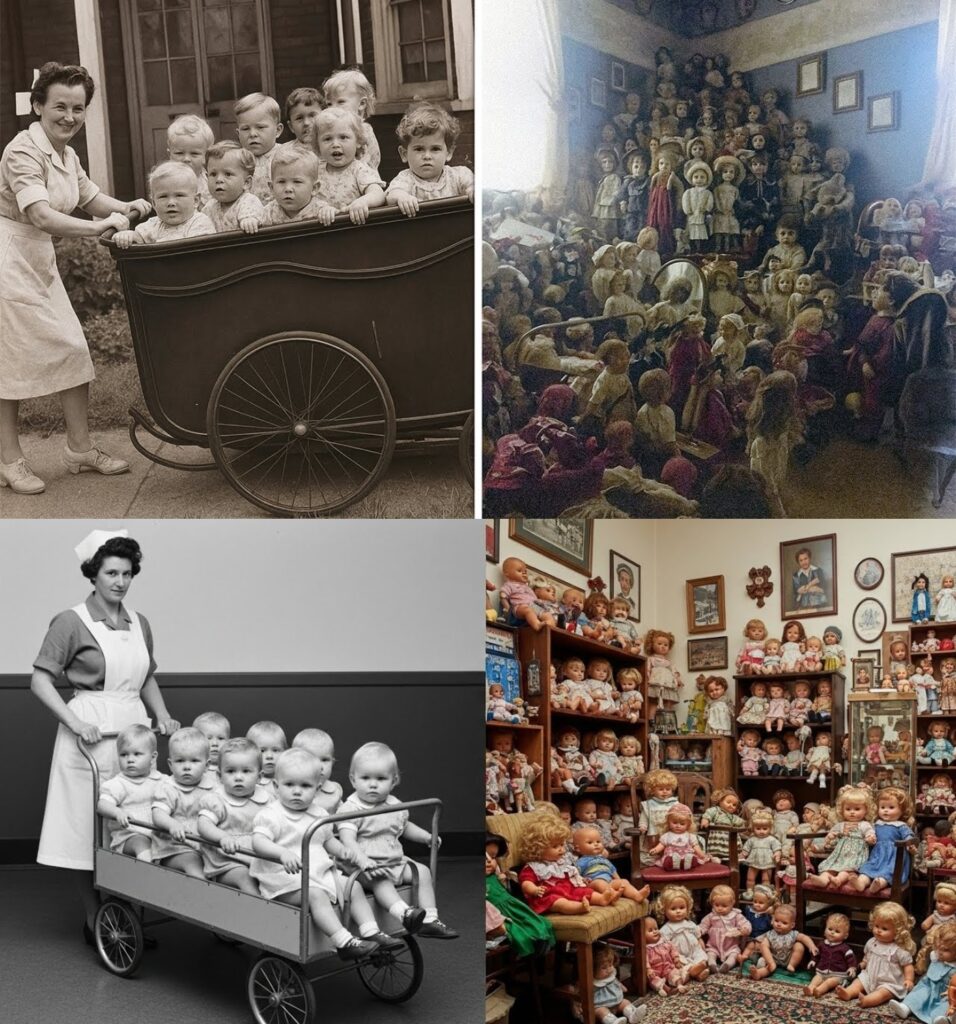
Inside was a small, windowless room lined from floor to ceiling with dolls.
Hundreds of them.
Some were porcelain, others rag-stuffed or carved from wood. All were arranged neatly on shelves, facing the door, as if waiting for someone to return. Each doll wore a child’s name tag, written in faded ink—names Ruth recognized from the orphanage’s missing persons report. Agnes. Clara. Peter. Elsie. Samuel. Forty-three in all.
Her knees buckled. The beam of her flashlight quivered across the wall, illuminating a single framed photograph hanging above the dolls: the children of Willowbrook, smiling in front of the orphanage, their matron standing proudly behind them. Only now, Ruth noticed—each child’s eyes in the photograph had been meticulously scratched out.
She stumbled backward and fled the room, gasping for air, her hands shaking uncontrollably. But even as she fled, one thought kept repeating in her mind: They never left.
When investigators returned days later, they confirmed Ruth’s discovery. The hidden room was real. The dolls were tagged with names that matched the official registry of missing children. But there was more. Forensic teams found remnants of bone dust in the seams of several dolls—minute traces that suggested something unspeakable.
The investigation that followed peeled back a layer of history no one was prepared for. Financial records revealed that in the late 1960s, Willowbrook had been part of a covert network funneling orphans into illegal medical trials and black-market adoptions. When exposure threatened, those involved had orchestrated the orphanage’s “relocation” — and its permanent silence. The matron, it turned out, had stayed behind. Her name was Margaret Hallow, a woman with no known family and no death record.
Her whereabouts remain unknown.
As news spread, the town of Willowbrook was forced to confront the ghosts it had ignored for decades. The building was declared a historical crime site and later demolished. But locals say that when the bulldozers came, strange things happened—equipment malfunctioned, radios went dead, and workers heard faint singing through their earplugs.
Ruth Caldwell never returned after that day. She donated the photograph to the state archives and burned the copy she’d found among her mother’s belongings.
Even now, travelers who pass the old site say the wind sounds different there—like a lullaby carried across the fields.
Because some disappearances aren’t accidents.
They’re business.