The Fire That Sparked a Movement: The Story of Hannah Clarke and Small Steps 4 Hannah
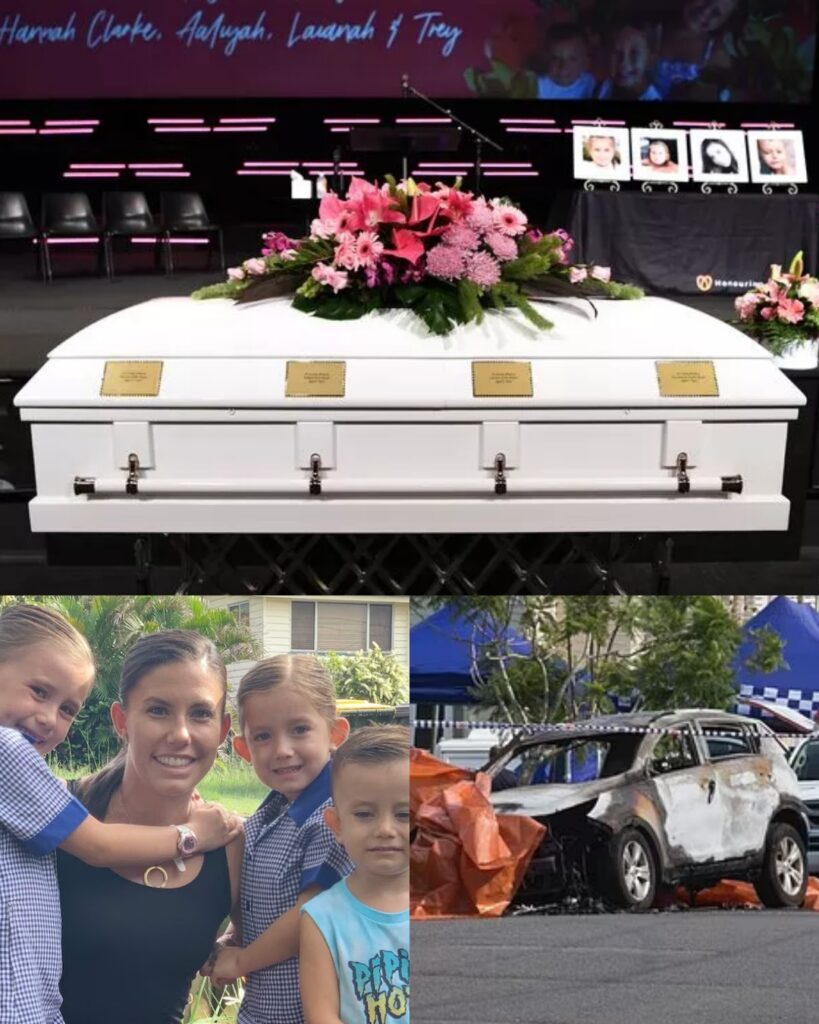
She was just a mom starting her morning — three kids in the car, ready for school. It was a routine every parent knows: the shuffle of bags, the hum of the engine, the chatter of children in the backseat. Hannah Clarke, 31, was doing what she loved most — being a mother to her three beautiful children, Aaliyah, 6, Laianah, 4, and Trey, 3. But that ordinary morning would end in unimaginable horror. Moments later, her world was set on fire.
On February 19, 2020, in the quiet Brisbane suburb of Camp Hill, Hannah’s estranged husband, Rowan Baxter, ambushed her as she prepared to drive away. He doused the car in petrol and set it alight with Hannah and their children trapped inside. The explosion was instant, the flames engulfing everything — lives, laughter, and futures — in a matter of seconds. Passersby tried desperately to help, but the fire was too fierce. The three children perished at the scene. Hannah, burned over most of her body, was still conscious when rescuers arrived.
Even in those agonizing final moments, Hannah showed extraordinary strength and clarity. She told police exactly what had happened — who had done it and how — determined that her story, and her children’s story, would not die with her. She was airlifted to the hospital, where she succumbed to her injuries later that day. Her final words, her courage, and her love became the heartbeat of a movement that would rise from the ashes of her tragedy.
In the weeks that followed, Australia was shaken. The nation mourned not only Hannah and her children but also the horrifying reality of domestic violence that had been hiding in plain sight. Rowan Baxter’s act was not an isolated moment of rage; it was the final chapter in a long pattern of control, coercion, and abuse. Hannah had left the relationship months before, seeking safety for herself and her children. She had taken every legal and practical step advised — sought help, reported her fears, built a safety plan — but the system failed to protect her.
Coercive control, the invisible weapon Baxter had wielded for years, was not fully recognized by the law at the time. He didn’t always bruise her body, but he broke her spirit piece by piece — monitoring her movements, isolating her from friends, manipulating her emotions, and using the children as leverage. It was the kind of abuse that leaves no visible scars but corrodes a person’s sense of freedom, safety, and self-worth.
After Hannah’s death, her parents, Lloyd and Suzanne Clarke, made a choice that no parent should ever have to make — to turn their grief into purpose. They founded Small Steps 4 Hannah, a foundation dedicated to ending domestic and family violence through education, awareness, and advocacy. Their mission: to ensure that no other family suffers as theirs did, and to shine a light on the hidden dynamics of coercive control.
The name “Small Steps 4 Hannah” carries deep meaning. It reflects Hannah’s own spirit — gentle, compassionate, determined — and the understanding that social change happens one step at a time. The foundation works to educate the public, policymakers, and professionals about the early warning signs of coercive control and the need for stronger legal protections. It also supports victims and survivors, helping them to rebuild their lives and reclaim their independence.
Through community programs, public speaking, and collaboration with law enforcement, the Clarke family has helped transform national conversations about domestic violence in Australia. Their advocacy contributed to Queensland’s landmark decision to criminalize coercive control — a powerful acknowledgment that abuse is not always physical, and that freedom should never come at the cost of one’s safety.
The story of Hannah Clarke is not only one of tragedy but also of transformation. Her life and her death forced a nation to confront uncomfortable truths about gendered violence, power, and the systems meant to protect victims. Her parents’ tireless advocacy has already saved lives — by giving survivors the language to name their abuse, by urging friends and families to ask the hard questions, and by holding institutions accountable for change.
Hannah did everything right. She sought help, she left, she tried to rebuild. Yet, like so many others, she was trapped by a system that didn’t yet understand the full reach of coercive control. Her story exposed those cracks — the lack of coordination between agencies, the inadequate risk assessments, and the legal blind spots that allowed abusers to continue manipulating from afar.
But Hannah’s legacy is rewriting that story. Every training session, every awareness campaign, every law reform proposal born from Small Steps 4 Hannah is a tribute to her courage. It is a message to victims that they are not alone, to bystanders that silence can kill, and to policymakers that real safety requires understanding the psychology of abuse, not just its physical symptoms.
Today, when people speak Hannah Clarke’s name, they speak of love, resilience, and the power of one woman’s voice to change an entire nation. Her parents continue to walk in her footsteps — not with anger, but with hope. They remind us that from the darkest moments, we can still find light; from unbearable loss, we can still create meaning.
Because Hannah Clarke did everything right. She followed the rules, she trusted the system, and she loved her children with all her heart. But the system failed her. And now, through Small Steps 4 Hannah, her story is ensuring it doesn’t fail others.
Her fire, once used to destroy, now burns as a beacon — lighting the way toward awareness, justice, and the promise of a world where no woman or child has to fear the person who claims to love them.
Small steps can change lives. Small steps can save lives. Small Steps 4 Hannah is proof of that.